




A new study shows that the Great Barrier Reef has lost half its coral in under three decades.
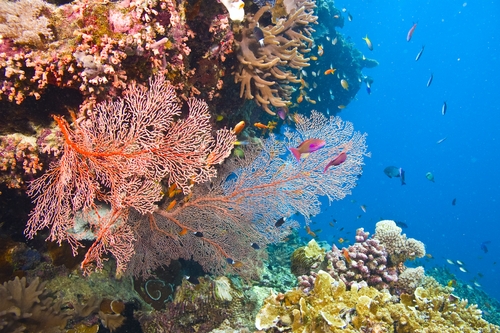 The study blames the killer Crown of Thorns starfish for the coral’s demise.
A comprehensive survey that monitored 214 of the individual reefs at the World Heritage site showed that the coral cover decreased to 13.8 per cent this year from 28 per cent in 1985.
If this is replicated across the whole Great Barrier Reef, which stretches 155 miles from shore and runs the length of Queensland’s coast, the figure is equivalent to the loss of coral over almost 19,300 sq miles of reef. This is over twice the area of Wales.
One of the significant factors in the loss of coral was explosions in population of Crown of Thorns starfish. Researchers say that they are responsible for more than two fifths of the overall loss of coral.
Under the correct conditions these starfish can each produce tens of millions of larvae, acting to trigger mass population booms that have resulted in entire reefs of coral being stripped.
Starfish outbreaks can be caused by the run-off of fertilisers into the sea from the shore. Development along the coast has increased their frequency from about two each century to one in every 15 years.
The starfish are large predators which have up to 21 arms that are covered in poisonous spikes. Each starfish can consume up to 107 sq ft of living coral each year and will eat almost any type that lives on the reef.
The starfish are slow moving but can consume large amounts of coral by landing on it and pushing their stomach out through their mouth. This allows them to digest an area of coral that is equivalent to their own 17-inch diameter in one swoop.
There are other key factors that affect the reef. Including cyclone damage, which caused about half of all coral death, and bleaching that is caused by rising sea temperatures which causes 10 per cent.
Experts say that while storms were found to have the largest overall impact, outbreaks of Crown of Thorns starfish are the most easily prevented threat.
A new study in the Proceedings of the National Academy of Sciences journal said that at the current rate it is declining the Great Barrier Reef could lose another 50 per cent of its remaining coral in 10 years.
Australian Institute of Marine Science, John Gunn, who led the study, said: “We can’t stop the storms, but perhaps we can stop the starfish. Our data show that the reefs can regain their coral cover after such disturbances [as Crown of Thorns outbreaks or cyclones], but recovery takes 10-20 years.”
He added that more studies are required to understand the causes of starfish population explosions and to discover ways of intervening to protect the reef from them.
Prof Ove Hoegh-Guldberg of Queensland University, the lead scientist on the Catlin Seaview Survey, which is a project to look at the deeper levels of the Great Barrier Reef, said the threat of a new outbreak was looming this year after the record flooding of Queensland in 2010.
He said: “When you have a flood along the coastline, or disturb the flow of nutrients into the sea, these starfish tend to outbreak so they go from being a minor player that you can hardly ever find on a reef, to being one or two per square metre.
“Suddenly you have got millions of them. Two years ago Queensland had record flooding along the coast, and two years after that we might have a really large Crown of Thorns outbreak developing across the central Great Barrier Reef.”
Such changes as with the significant loss of coral on the Great Barrier Reef are fascinating and thank goodness scientists spend their time looking into these things and finding ways to intervene to protect the reef. There are so many changes afoot on this planet of ours and we all need to help to safeguard it for future generations to enjoy.